Showing posts with label technology. Show all posts

Tuesday, 26 December 2017

100 Reasons Why You Need To Embrace Live Chat

You are undoubtedly aware of the importance of customer service on your online business’ road to success. But, what you may not know is that customers’ expectations have now reached new heights, demanding instant support and fast acting. In order to keep up with the latest trends, it is essential to improve customer experience. If you cannot think of an innovative way to do so – we have the answer.
Live chat is the way to go!

Make no mistake, live chat is not just a way for the customers to get in touch with the seller. It’s much more than that! Live chat is the untapped potential that will help you build rapport with your visitors and boost conversion rates. More importantly, live chat provides immediate answers, thus building confidence in your brand and increasing customer satisfaction. 
Check out this Website Builder infographic to uncover the full potential of live chat and find out why you should embrace it as soon as possible!


Read More »

Wednesday, 14 September 2016

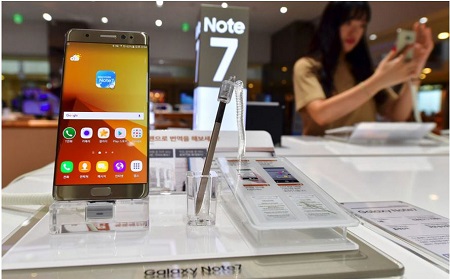
US warns against the use of Samsung Galaxy Note 7

The US Federal Aviation Administration strongly urged passengers Thursday not to turn on or charge Samsung Galaxy Note 7 smartphones on aircraft following recent reports of explosions from faulty batteries.

The South Korean smartphone maker last week suspended sales of the “phablet” and recalled 2.5 million units following the reports.

“In light of recent incidents and concerns raised by Samsung about its Galaxy Note 7 devices, the Federal Aviation Administration strongly advises passengers not to turn on or charge these devices on board aircraft and not to stow them in any checked baggage,” the FAA said in a statement.

Qantas and Virgin Australia also told customers Thursday not to use or charge the devices on their planes.
 v

Samsung is the world’s top smartphone maker, outpacing its American rival Apple.

DON'T FORGET TO LEAVE YOUR COMMENTS AND ALSO SHARE THIS POST
Read More »

Thursday, 18 August 2016

How To Use Flashlight As Notification On Your Android and Iphone devices

ever thought of activating a new way of call notification for your smartphone. Yeah! You can use your Android and iPhone Camera LED Flashlight to notify incoming calls on your Android phone.


While on Silent Mode, you can’t hear your ringing tone for  incoming calls and messages . the  Silent mode can make you lose many important calls you wish to receive if you had seen it coming in. 

However With this amazing trick we will be discussing today, you can easily get a notification LED light blinking in your smartphone regardless of silent mode.

Here In this post, we will discuss a simple method on how you can use flashlight as a notification for  your incoming calls and messages on both Android and iPhone devices .

How To Use Flashlight Notification For Incoming Calls On Android device

First Download Flash Alert Android app from Google store and Install the app on your Android phone.
After successfully installing the app, it will ask you to do the test. Just follow the instructions on the popup and do the test.
Click on settings, Make sure Flash Alerts is on and the Incoming call option is on

Now to test this you can use a friend’s phone to call your line and you will see your phone’s Led flashlight blinking.

How to Enable LED Flashlight Notification on iPhone


For  iPhone you don’t need any app. All you need to do is to enable Flash alerts in your iPhone default settings.
On your iPhone home screen, tap on Settings > General.
Then Tap on Accessibility and Turn LED Flash for Alerts ON.


That's all on how to use flashlight as notification for incoming calls on smartphone..enjoy

DON'T FORGET TO LEAVE YOUR COMMENTS AND ALSO SHARE THIS POST
Read More »

Tuesday, 9 August 2016

How to Make a Smartphone Projector With A Shoebox

Did you know you can turn an old shoebox and some office supplies into a Smartphone Projector? Yes, you can! It is a very fun, simple and easy project that you could do at home. Yes, you can! It is a fun, simple and easy physics experiment that you could do at home.


Turn your Smartphone into a Projector with this Hack and enjoy movies and videos on the big screen. Here we do this DIY from simple Office Supplies.

With this in mind, you may have flirted with the idea of turning your handset into a DIY smartphone projector. This video by TechBuilder can help you bring this concept to life, so long as you have the following items:

https://www.youtube.com/watch?v=Tx4vPeL9y2g

  • A Hack-saw.
  • A Shoe Box.
  • A Magnifying Glass (for the projector lens).
  • A Foam Board.
  • A Box Cutter.
  • A Glue Gun.
  • A Ruler.
  • A Compass.
  • Some Cellotape.
  • Your Smartphone.


What to Look Out for When Making Your DIY Smartphone Projector
With these items, you can begin to construct your simple and yet ingenious DIY smartphone projector using the steps in the video. Remember to keep the following points in mind:

  • Use lots of glue when securing the shoe box. This prevents it from wobbling when the section is cut for the projector lens.
  • Use a compass to guide the box-cutter blade as this creates a precise hole for the lens.
  • When securing your smartphone against the foam board, ensure that it is placed centrally and aligned with the lens.
  • Remember to focus the lens (once complete) by moving the smartphone back and forth within the casing.


Frequently Asked Questions and Answers
Can you make modifications to optimize the Audio Output?
You can punch a small hole on the casing and connect an auxiliary cable. If not, consider using either a Bluetooth speaker or a sound bar to optimize the sound.

How can I improve the clarity of the picture after calibrating?
Before you place your smartphone in the casing, adjust the sharpness, brightness, and contrast settings the get the best clarity and quality of the image.

Can I use any phone on this project?
While the video uses an iPhone, you can use any Android or Apple handset so long as the casing is cut to a proportionate size.


CLICK TO SEE THE STEP BY STEP GUIDE 

DON'T FORGET TO LEAVE YOUR COMMENTS AND ALSO SHARE THIS POST
Read More »

Monday, 8 August 2016

The World's Most Dangerous Computer Viruses


Here are five most dangerous computer viruses of all time:

1. ILOVEYOU
Perhaps the most virulent computer virus ever created, the “ILOVEYOU” virus managed to wreck PCs all across the world. Infecting almost 10% of the world’s PCs connected to the Internet, the virus caused a total damage of around $10 billion.

The virus is transmitted via email with a subject line “ILOVEYOU,” which is a radical human emotion that no one can ignore. To make it even more alluring, the email contained an attachment that read something like this: Love-Letter-For-You.TXT.vbs. The moment someone opened the file, the virus emailed itself to the first 50 contacts available in the PC’s Windows address book.


2. Melissa
Melissa became the breaking news on March 26, 1999, after hitting the new age of emailing. Built by David L, Melissa was spread in the form of an email attachment by the name “list.doc.”


When a person clicked upon the attachment, the virus would find the Microsoft Outlook address book and email itself to the first 50 contacts on the list having a message “Here is that document you asked for…donot show anyone else.” Later on, FBI arrested David L and slapped him with a fine of $5000 for creating the wildest virus of its time.


3. My Doom
My Doom hit the malware world in 2004 and spread exponentially through email with random addresses of senders and subject lines. Infecting somewhere around two million PCs, My Doom smashed the cyber world by instigating a tremendous denial of service attack. It transmitted itself via email in a specially deceitful way that a receiver would first consider a bounced error message that read “Mail Transaction Failed.”

However, as soon as the receiver clicked upon the message, the attachment executed and the worm transmitted to email addresses found in the user’s address book. It is easy to believe that this mass mailer worm caused a damage of almost $38 billion.


4. Code Red
Taking advantage of the Microsoft Internet Information Server’s flaw, Code Red spread on the network servers in 2001. Here is an amusing fact about this dangerous virus—it didn’t need you to open an email attachment or execute a file; it just required an active Internet connection with which it ruined the Web page that you opened by displaying a text “Hacked by Chinese!” It’s no surprise that this virus devastated nearly $2.6 billion dollars by hitting almost one million PCs.

And in less than a week’s time, the virus brought down over 400,000 servers that included the White House Web server as well.


5. Sasser
Sasser was a Windows worm that was discovered in 2004. Apparently, it would slow down and crash the PC, making it even hard to reset without cutting the power. And its effects were surprisingly troublesome as well, with millions of PCs being infected and crucial, significant infrastructure affected.

The worm played on a buffer overflow susceptibility in Local Security Authority Subsystem Service (LSASS) that monitors the safety policy of local accounts causing crashes to the PC. The devastating effects of the virus were massive resulting in over a million infections. This included critical infrastructures, such as new agencies, hospitals, airlines, and public transportation.


6. Conficker


Also known as Downup or Downadup, Conficker is a worm of unknown authorship for Windows that made its first appearance in 2008. The name comes form the English word, configure and a German pejorative.It infects computers using flaws in the OS to create a botnet. The malware was able to infect more than 9 millions computers all around the world, affecting governments, businesses and individuals. It was one of the largest known worm infections to ever surface causing an estimate damage of $9 billion.
The worm works by exploiting a network service vulnerability that was present and unpatched in Windows. Once infected, the worm will then reset account lockout policies, block access to Windows update and antivirus sites, turn off certain services and lock out user accounts among many. Then, it proceeds to install software that will turn the computer into a botnet slave and scareware to scam money off the user. Microsoft later provided a fix and patch with many antivirus vendors providing updates to their definitions.


7. Flashback

Though not as damaging as the rest of the malware on this list, this is one of the few Mac malware to have gain notoriety as it showed that Macs are not immune. The Trojan was first discovered in 2011 by antivirus company Intego as a fake Flash install. In its newer incarnation, a user simply needs to have Java enabled (which is likely the majority of us). It propagates itself by using compromised websites containing JavaScript code that will download the payload. Once installed, the Mac becomes part of a botnet of other infected Macs.
The good news is that if it is infected, it is simply localized to that specific user’s account. The bad news is that more than 600,000 Macs were infected, including 274 Macs in the Cupertino area, the headquarters of Apple. Oracle published a fix for the exploit with Apple releasing an update to remove Flashback from people’s Mac. It is still out in the wild, with an estimate of 22,000 Macs still infected as of 2014.a


Computers are amazing, but they just do what they’re told, and when viruses tell them to do bad things, it can create a lot of damage.
Read More »

Wednesday, 27 July 2016

How To Convert a Single-SIM Smartphone Into a Multi-SIM Phone

The need for a multi-SIM capable device is virtually non-existent in the United States and Worldwide. It is however, a very real consideration in other parts of the world, where rates, coverages, and other features do not necessarily overlap.


Device subsidies, and well-built networks in developed markets have effectively eliminated the need for dual-or-triple-SIM devices. Multi-SIM devices can be handy though if you are creative with pre-paid plans, travel a great deal, or need to stretch the usefulness of every dollar you spend.
Simore (SIM + More) is a multi-SIM solution expert which has come up with a solution in the form of a portable SIM holder. It does not require any rooting or jailbreaking. It simply works like a play-n-plug device.


However, there is still a slight restriction when it comes to the service provider and the phone company. It should be noted that unless your handset is unlocked, you will be restricted to SIM cards from the carrier to which your handset is locked — which is very obvious. Still,

Simore helps in carving out the best-fit plans for you. Before calling a number, you just have to choose an operator and it works.

Don’t have an iPhone? Don’t worry, there are dual and triple SIM card adapters for a whole array of handsets, including the Samsung Galaxy S6 and S6 Edge, the LG G4 and G5, or the Sony Xperia Z5, Z5 Compact, or Z5 Premium.

With Simore Gadget technology you can add up to 5 SIMs on a single Smartphone.


Here are some of the features of the Simore Multi-SIM holder:
  • Use up to 5 SIM cards in one mobile phone
  • Manage two or more phone numbers with one single click
  • Send and receive calls & SMS on multiple SIM cards with only one phone
  • Centralize all SIM data on one single mobile phone
  • Select the SIM you want to use
  • Switch operators without turning off the phone
  • Besides the above features, this SIM solution by Simore is also compatible across different geographical locations and different service providers like AT&T, Vodafone, Orange, Sunrise, O2 etc.


Prices for the kits alone start at about €35 or $40, and go up to about €99 or $120 for Bluetooth multi-point access nodes that handle the SIM cards for you. SIMore ships worldwide.


DON'T FORGET TO LEAVE YOUR COMMENTS AND ALSO SHARE THIS POST
Read More »

Sunday, 10 July 2016

Facebook Messenger starts testing end-to-end-encryption in secret chat mode

Facebook is currently testing their new added feature on the facebook messenger app  to ensure that, as it becomes an indispensable way to communicate — people are able to do so securely and safely.


Messenger uses secure communications channels (just like banking and shopping websites) as well as Facebook’s powerful tools to help block spam and malware. We’ve heard from you that there are times when you want additional safeguards — perhaps when discussing private information like an illness or a health issue with trusted friends and family, or sending financial information to an accountant.


Facebook officially announced today that they’re testing end-to-end encryption within Messenger, locking down conversations so that even Facebook can’t access the content therein. However, unlike other messaging platforms where the end-to-end encryption is active by default and covers all conversations, Facebook will let Messenger users turn it on in a chat-by-chat basis. To differentiate between these standard and encrypted conversations, Facebook is calling them Secret Conversations.


“To enable you to do this we are starting to test the ability to create one-to-one secret conversations in Messenger that will be end-to-end encrypted and which can only be read on one device of the person you’re communicating with. That means the messages are intended just for you and the other person — not anyone else, including us. Within a secret conversation, you can also choose to set a timer to control the length of time each message you send remains visible within the conversation. Our technology uses the Signal Protocol developed by Open Whisper Systems. You can read more about the technical details here.”

Enabling secret conversations within Messenger is optional. Facebook explained that some people prefer to use the app across multiple devices, but when you have secret conversations, you’re limited to just one device. This option is only available for text conversations, so GIFs, videos, payment transactions, or “other popular Messenger features” are not currently supported.


The company emphasized that it’s currently just testing out this feature but added that the security feature is likely to be made more available later this summer. In a blog post, Facebook said “We are putting a lot of thought into the design and implementation of this feature, and we are grateful to the security and privacy experts who have given us their valuable input.” A major player in the development of this feature is Open Whisper Systems, a security-related technologies provider of private messaging and calling.


source:Facebook Newsroom
DON'T FORGET TO LEAVE YOUR COMMENTS AND ALSO SHARE THIS POST
Read More »

Alibaba Group Unveils Smart 'Internet-Connected Car

Alibaba Group on Thursday launched a first-of-its-kind "Internet-connected car" that can be scaled up for mass production in the near future.

The YunOS-enabled car named "OS'Car RX5" has been developed in collaboration with SAIC Motor Corporation.


"YunOS for cars" is a smart operating system from Alibaba Group which is tailor-made for the automotive industry, the company said in a statement.

The car has advanced fuel technology, more powerful accelerator, lower oil consumption and have a shorter braking distance.

With cloud-based data, YunOS provides OS'Car RX5 drivers with a series of innovative features like an intelligent map. 
The car is able to take direct commands through smart voice control, creating a more natural and safer driving environment. Audio is the primary mode for controlling the system.

The smartcar was unveiled by Alibaba on Wednesday and will be available in China from August with a starting price of RMB 148,800 (approximately $22,300). The basis is the Roewe RX5 compact SUV, built by state-owned Chinese automaker SAIC. But what makes the smartcar unique is that it is running Alibaba’s own operating system known as YunOS.


“What we hope to achieve in the coming decades is to inject machines with human wisdom,” said Alibaba Chairman and founder Jack Ma. “Just as software programs have made the phone smarter today, YunOS will make cars an even more indispensable part of human life in the future society.”

Through YunOS, occupants can automatically pay for items such as tolls, parking and fuel stops. They can also access online services such as booking, navigation and entertainment. Each vehicle also gets a unique ID that allows the operating system to not only recognize different users but also make recommendations for music, air temperature or nearby restaurants based on past trips.

And since YunOS will be open to third-party developers, there will likely be a long list of apps owners can install to provide more functionality down the road.


Alibaba says it hopes its smartcar will help spur the development of connected transportation and infrastructure, where everything is connected though a concept referred to as the Internet of things (IoT).

DON'T FORGET TO LEAVE YOUR COMMENTS AND ALSO SHARE THIS POST
Read More »

Friday, 1 July 2016

Facebook Messenger Football: [How to play hidden Euro 2016 game]

Have you heard about Facebook’s secret new football game? Well it’s tucked away inside the Messenger app, so here’s how to play it.

Facebook is celebrating the Euros with a new – and hidden – swipe-action football game embedded in the mobile Messenger app. Bear in mind that this won’t work on the web version of Messenger.
David Marcus, who heads up Messenger at Facebook, said:
“Our little [basketball] Messenger game we launched for March Madness and the NBA season was played over one billion times (!) over the course of the latest 3 months. Since you loved it so much, and it’s the Euro 2016 & Copa America


HOW TO PLAY FACEBOOK MESSENGER FOOTBALL GAME
ü  Make sure you've updated to the latest version of Facebook Messenger
ü  Send the football emoji to a friend
ü  Tap the football emoji in the chat
ü  The game should appear automatically
The challenge is to keep the football from touching the ground. The game keeps your best score intact for the next time you use the emoji and want to replay.
The interface is simple, with the ball bouncing about the white screen, more vigorously as the level advances. Users can easily exit the game, and back to their conversation whenever they feel like. There's no pausing the game though, you'll have to end it to continue chatting.
Facebook had done a similar trick in March with its Messenger Basketball game. It got activated in the same way, but needed the basketball emoji for starting it. Facebook also claimed that the game had received 300 million plays in just one week.
You can also unlock a secret chess game by typing “@fbchess play” in a Messenger conversation


The new game is being rolled out globally to all users. The update should have hit the App Store and Google Play in your region, but if it hasn't, it will soon.

DON'T FORGET TO LEAVE YOUR COMMENTS AND ALSO SHARE THIS POST
Read More »

How to play Facebook Messenger’s secret basketball game


Facebook trying as much as possible to help the users stay out of boredom, with the introduction of a secret basketball game in facebook messenger.

What better way to spend your Day than throwing virtual balls at digital hoops?
Facebook has updated its Messenger app with a new hidden game for you to play.
The app’s developers have coded in a basketball mini-game that’s only accessible to those with the requisite know-how.
Check it out:


HOW TO PLAY FACEBOOK MESSENGER BASKETBALL GAME

To play the game, you’ll need to load up Messenger and head into a conversation with a friend.
Then, dive into the emoji panel and select the basketball icon, and send that to a buddy.
Once the icon shows up in the chat, you can tap the emoji and you’ll be taken into the basketball minigame.

The objective of the game is (unsurprisingly) to get the ball through the hoop by swiping your finger upwards across the screen.
The ball will spawn at different locations, so some shots can be trickier than others.
What’s more, once you hit a 10 hoop streak, the backboard will start moving, making the game much more difficult.


DON'T FORGET TO LEAVE YOUR COMMENTS AND ALSO SHARE THIS POST
Read More »

Thursday, 30 June 2016

Sony Set to Develop a Robot That Can Connect Emotionally With People

The Japanese tech giant Sony announced on Wednesday that it was working on developing a robot which can connect emotionally with people, and expects to launch it soon.

At a press conference on Wednesday, where the company unveiled its strategy for 2017, Sony President Kazuo Hirai said they want to make robots capable of winning people's affection.


This will mark Sony's return to the market of artificial intelligence (AI), robots for homes, an area the company pioneered in 1999 when it launched its robotic dog Aibo, which it stopped manufacturing in 2006, EFE news reported.

Sony is looking to combine its strengths in audiovisual technologies and home entertainment with the latest advances in robotics and AI, to introduce a new business model that will offer new experiences to users, he added.


Last month, Sony acquired a stake in the US startup Cogitai, which specialises in creating continual AI learning programmes.

Hirai also said the launch date for Sony's new home robot - which will be directly in competition with Softbank's android robot "Pepper", launched in June 2015 - has not been decided yet.

He set an operating profits target of over $4 billion for the next fiscal and said the company is optimistic about continuing to grow owing to its entertainment and electronics divisions.


DON'T FORGET TO LEAVE YOUR COMMENT AND ALSO SHARE THIS POST

Read More »

Tuesday, 28 June 2016

Temporary Blindness Cases Tied to Smartphone Use in Dark

Danger associated with the use of smartphones in the dark.
Warning: Looking at your smartphone while lying in bed at night could wreak havoc on your vision.
Two women went temporarily blind from constantly checking their phones in the dark, say doctors who are now alerting others to the unusual phenomenon.

The solution: Make sure to use both eyes when looking at your smartphone screen in the dark.
In Thursday's New England Journal of Medicine, doctors detailed the cases of the two women, ages 22 and 40, who experienced "transient smartphone blindness" for months.
The women complained of recurring episodes of temporary vision loss for up to 15 minutes. They were subjected to variety of medical exams, MRI scans and heart tests. Yet doctors couldn't find anything wrong with them to explain the problem.
But minutes after walking into an eye specialist's office, the mystery was solved.
"I simply asked them, 'What exactly were you doing when this happened?'" recalled Dr. Gordon Plant of Moorfield's Eye Hospital in London.
He explained that both women typically looked at their smartphones with only one eye while resting on their side in bed in the dark - their other eye was covered by the pillow.

"So you have one eye adapted to the light because it's looking at the phone and the other eye is adapted to the dark," he said.
When they put their phone down, they couldn't see with the phone eye. That's because "it's taking many minutes to catch up to the other eye that's adapted to the dark," Plant said.
He said the temporary blindness was ultimately harmless, and easily avoidable, if people stuck to looking at their smartphones with both eyes.
One of the women was relieved the short-term blindness didn't signal a more serious problem like an imminent stroke. He said the second woman was more skeptical and kept a rigorous monthslong diary tracking her fleeting vision loss before she finally believed him. But she couldn't stop checking her phone for messages from bed, he said.
Dr. Rahul Khurana, a spokesman for the American Academy of Ophthalmology, called it a fascinating hypothesis but said two cases weren't enough to prove that one-eyed smartphone use in the dark caused the problem. He also doubted whether many smartphone users would experience the phenomenon.

Khurana, who acknowledged that he's an avid cellphone user, said that he and his wife tried to recreate the scenario on a recent evening, but had difficulty checking their phones with only one eye. "It was very odd," he said.

DON'T FORGET TO LEAVE YOUR COMMENTS AND ALSO SHARE THIS POST
Read More »

Saturday, 25 June 2016

Apple Watch 2 Set to Launch Alongside iPhone 7 in September: Report

Past reports indicated that the Apple Watch 2 may be launched during WWDC, but that didn't happen. If this report is true, then the next-generation Apple Watch will see an unveil alongside the iPhone 7. The volume of shipments ordered also suggests that Apple is betting big on the next-generation Apple Watch 2.

Apple is anticipated to launch the iPhone 7 in September this year. New reports have surfaced claiming that the Apple Watch 2 may also see a launch alongside the flagship smartphone.
The Cupertino giant is pushing its suppliers to mass produce Apple Watch, and the shipment is expected in the third quarter. Digitimes cites supply chain sources, and reveals that as many as two million Apple Watch smartwatches are expected to be shipped in the third quarter.
"Shipments of chips and components for the second-generation Apple Watch are set to begin in the third quarter. Orders for the upcoming Apple Watch have been higher-than-expected. Judging from the orders, the sources estimated that about two million units of the new Apple Watch could be shipped monthly," the report said.

Another rumour regarding the release date of the Apple Watch 2 comes from China - more specifically, the chairman of Quanta, Barry Lam. Quanta manufactured the first-generation Apple Watch, and we expect it'll also be the manufacturer of the second-generation device, so when the chairman announced a general release date window at an investors meeting, people paid attention.

According to reports, Lam claims that we'll be seeing limited stock of the Apple Watch 2 near the end of Q2 2016, with more stock becoming available in Q3 2016. Based on this, it looks like the Apple Watch 2 will have a possible June 2016 release date, which falls in line with the analyst claims above.
Rumours suggest that Apple Watch 2 won't change much in design, but will be at least 20 to 40 percent thinner than its predecessor. Apple may be looking to improve the battery life on the Apple Watch 2, seen by many to be a big drawback in its current offering in the market. The smartwatch is also expected to support cellular connectivity. However, it is worth noting that all of these are just speculations, and must be taken with a pinch of salt.


The iPhone 7 has also been subjected to many leaks, and is expected to sport a design similar to the iPhone 6s. The antenna bands may shift to the edges, and the larger variant may embed 3GB of RAM to accommodate the rumoured dual camera setup. There are also speculations of a Smart Connector, but reports about that are conflicting.


DON'T FORGET TO LEAVE YOUR COMMENTS AND ALSO SHARE THIS POST
Read More »

recent comments